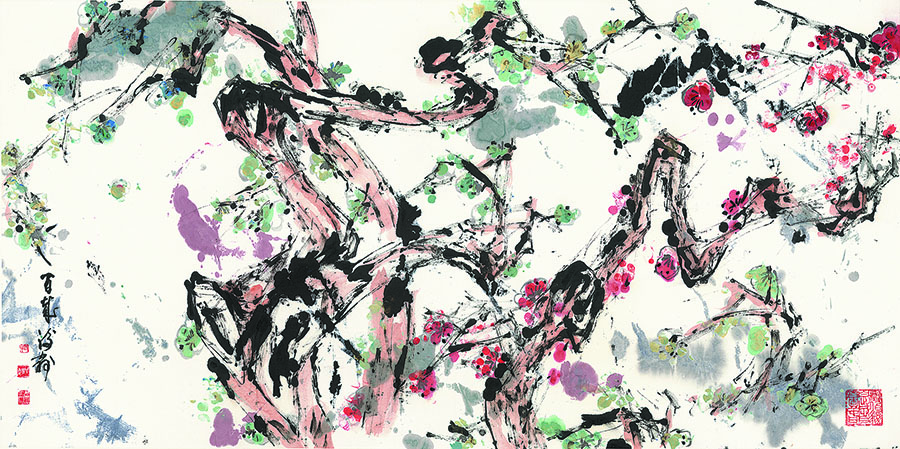
Finger Painting
Introduction
Finger painting is an expressive and tactile form of art that uses fingers as the primary tool for applying paint to a surface. This method allows artists to create intricate designs and textures that are difficult to achieve with brushes or other traditional tools. Finger painting is known for its spontaneity and the direct connection between the artist and their work, often resulting in vibrant and dynamic compositions.
Historical Background
The origins of finger painting can be traced back to early human history when prehistoric people used their hands to apply natural pigments to cave walls. This primitive form of expression allowed early humans to document their environment and experiences in a visual manner. Throughout history, finger painting has been practiced in various cultures, often as a folk art tradition. This style was popularized by artists such as Gao Qipei, who used the edges of their palms and fingers to create ink paintings.
Technique and Materials
Finger painting involves using fingers to apply paint onto a surface, typically paper or canvas. This method encourages exploration of texture, pressure, and gesture, allowing artists to create a wide range of effects. The choice of paint is crucial; water-based paints such as tempera or acrylics are commonly used due to their ease of use and quick drying times. Artists may also use inks or natural dyes to achieve different textures and finishes. The process often begins with a sketch or an idea, but the final piece evolves organically as the artist manipulates the paint with their fingers.
Prominent Finger Painters
Sun Ruicheng
Sun Ruicheng, an artist based in Cangxian county, North China’s Hebei province, is known for his finger paintings. His work has been exhibited and introduced to students, demonstrating the technique’s versatility and appeal. Sun's approach focuses on the tactile nature of finger painting, allowing him to connect deeply with his art and inspire others to explore this unique form of expression.
Zou Cao
Zou Cao, a Beijing-based artist, has utilized finger painting as a means of community engagement and charity. In a recent project, Zou collaborated with rural elders to create a series of finger paintings depicting the Temple of Heaven. These works were later turned into prints and donated to the Temple, highlighting the social and cultural relevance of finger painting as a communal activity.
Liu Bojun
Liu Bojun, a renowned ink artist from Sichuan province, incorporated finger painting into his diverse repertoire. Known for his vibrant flower-and-bird style paintings, Liu's finger paintings are characterized by their dynamic and expressive brushwork, achieved through the direct application of ink with his fingers. His work reflects a deep understanding of traditional Chinese painting techniques, combined with a modern and personal touch.
Cultural Significance
Finger painting is not only a medium of artistic expression but also holds cultural and educational significance. It is often used as a teaching tool in early childhood education, promoting creativity and sensory development. In China, finger painting is regarded as an important cultural heritage, reflecting centuries of artistic tradition and innovation. The practice allows artists to explore new dimensions of creativity, breaking free from the constraints of conventional tools and techniques.








